Ipsos Reveals Special Research on the Booming Electric Vehicle Market: Car Users Eyeing BEVs as Their Next Vehicle
At the Empire Tower conference room, Ipsos Ltd., a global leader in market research and consumer opinion surveys, held the launch of the report titled "Thailand Auto Trend - The Rise of Pure Electric Cars". The event was led by Mr. Setthasith Pornboonyarat, Associate Director, who presented the study's findings on the role of electric vehicles in transforming the automotive industry in Thailand, market trends, consumer responses, and key factors influencing growth and competition in the electric vehicle market. New brands have entered the competition for market share, driven by a combination of supportive government policies and aggressive market penetration by Chinese electric vehicle manufacturers.
Mr. Setthasith revealed that the automotive landscape in Thailand is transitioning from combustion engine vehicles to electric vehicles, influenced by several factors including government incentives and changing consumer attitudes. There is an increasing acceptance of this vehicle type, with one significant factor being the rapid development of electric vehicle technology and its affordability.
The Overall Thai Car Market Contracts, but Electric Vehicles Continue to Grow
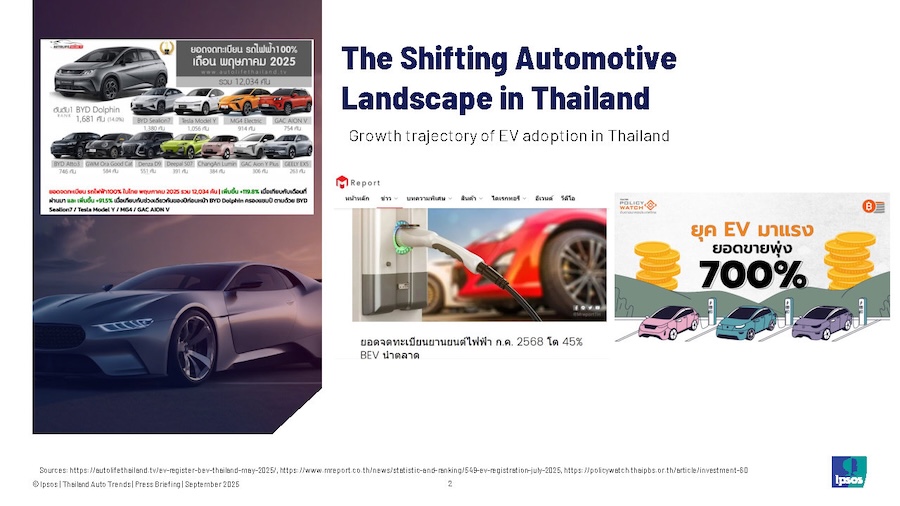
Although the overall car market in Thailand has seen unprecedented sales declines since 2009 due to various factors such as household debt and stricter lending policies, the electric vehicle market has continued to grow. In the first quarter of 2025, sales of xEV (BEV + PHEV + HEV) vehicles increased significantly to 67,000 units, reflecting a robust growth of 7% compared to the same period last year. Notably, this segment accounted for a substantial 40.2% of total vehicle sales in this quarter, with hybrid vehicles (HEV) dominating the xEV market share at 62%, indicating a potential transition towards full electric vehicles.
New Players Dominate the Market with High Sales at the Motor Show
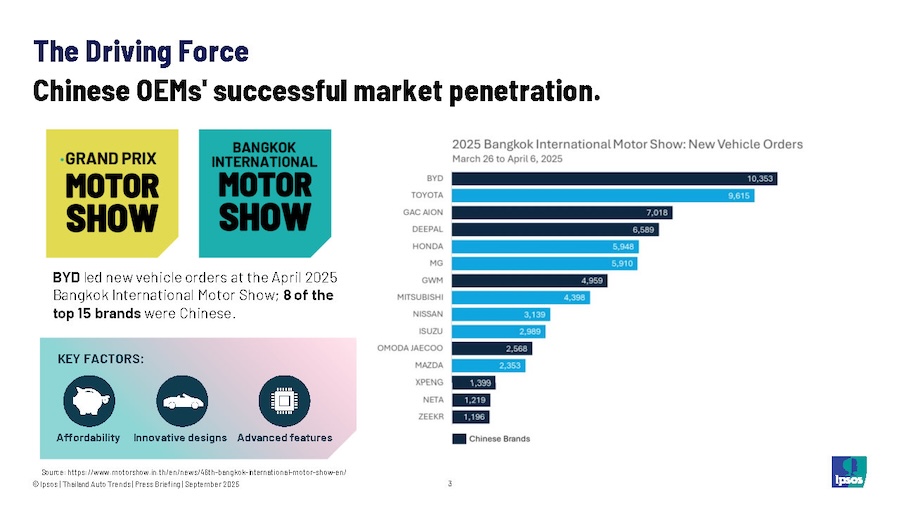
Regarding competition and brands, Mr. Setthasith Pornboonyarat stated that electric vehicles vary by operational systems, such as BEV (Battery Electric Vehicles), PHEV (Plug-in Hybrid Electric Vehicles), and HEV (Hybrid Electric Vehicles). The electric vehicle industry in Thailand is primarily driven by Chinese manufacturers, whose introduction of affordable products and strategic approaches has become a significant turning point. This is evidenced by the sales statistics from the 46th Bangkok International Motor Show, where over half of the top 15 booked brands were from China (8 out of 15), surpassing competitors from Japan and Europe. BYD led with 10,353 bookings, followed by GAC AION, Deepal, and GWM with 7,018, 6,589, and 4,959 bookings, respectively.
Consumer Motivations for Switching to Electric Vehicles
Thailand aims to become the "EV Hub" of Asia, with the government targeting to produce 30% of total vehicle production as EVs by 2030, supported by policies such as tax reductions, purchase subsidies, investment incentives for manufacturers, and the development of charging stations.
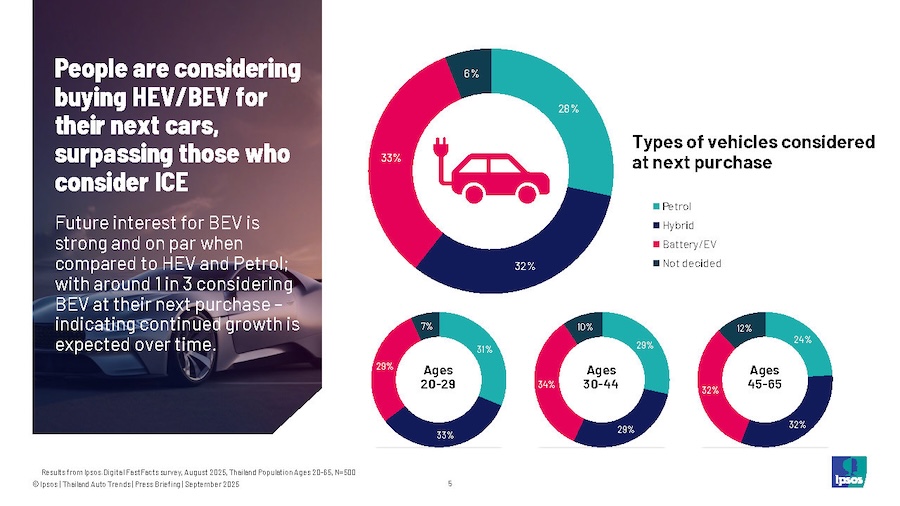
There is a growing number of Thai consumers considering purchasing electric vehicles. When asked about their next vehicle purchase, 33% of car owners indicated they would consider an electric vehicle (EV) over a combustion engine vehicle (28%), with another 32% considering hybrid vehicles. This trend is consistent across all age groups, with each group showing interest in EVs and HEVs over combustion engine vehicles. The breakdown by age is as follows:
Age 20-29: 33% interested in hybrid vehicles, 31% in combustion vehicles, 29% undecided. Age 30-44: 34% interested in BEVs, 29% in HEVs, 29% in combustion vehicles, and 10% undecided. Age 40-65: 32% interested in BEVs and HEVs, 24% in combustion vehicles, with 12% undecided.
Mr. Setthasith further revealed that the main factors influencing the decision to purchase EVs are price and value (57%), environmental concerns (51%), superior technology (49%), and a good driving experience (41%).
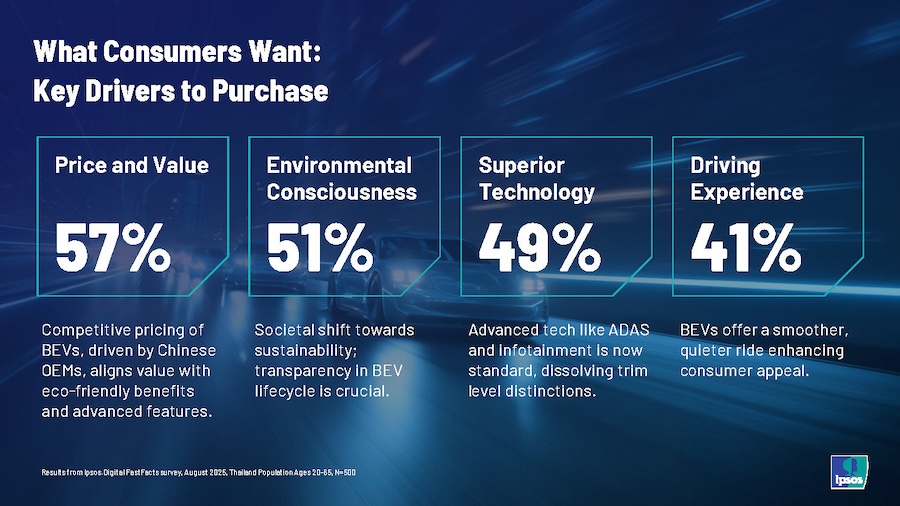
Price and value have always been crucial factors in consumer decision-making. Environmentally friendly vehicles with high specifications and excellent driving performance often come at a higher price. However, in the era of electric vehicles, consumers can own environmentally friendly cars with superior performance and modern features at accessible prices.
Barriers to Electric Vehicle Expansion
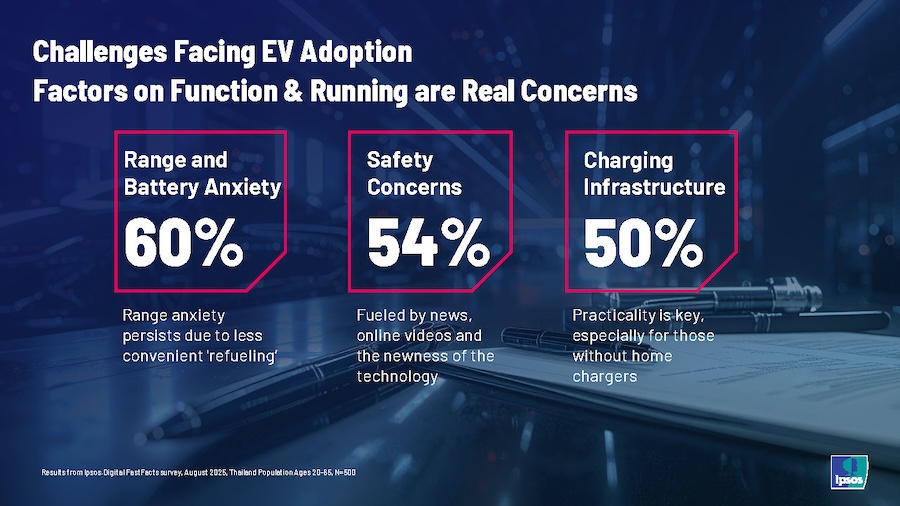
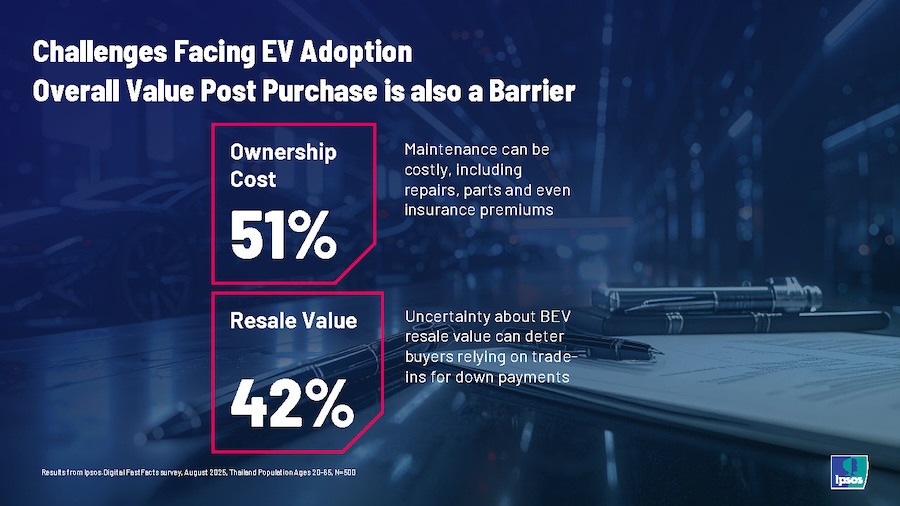
However, the survey also revealed challenges and obstacles that make many hesitant to purchase EVs. The primary concern for manufacturers to consider for long-term success remains the issue of range and battery life (60%), followed by safety concerns (54%), including risks associated with batteries. Other significant concerns include overall ownership costs (51%), insufficient charging stations (50%), and uncertain resale value (42%).
Ipsos also analyzed key conclusions to provide insights for new players in the electric vehicle market, emphasizing important factors that influence consumer decisions:
- After-sales service: Consumers are concerned about expertise and delays in spare parts supply.
- Battery quality: Remains a major concern regarding lifespan and performance in Thailand's humid climate.
- Software reliability: Consumers have doubts about long-term stability and software update processes in vehicles.
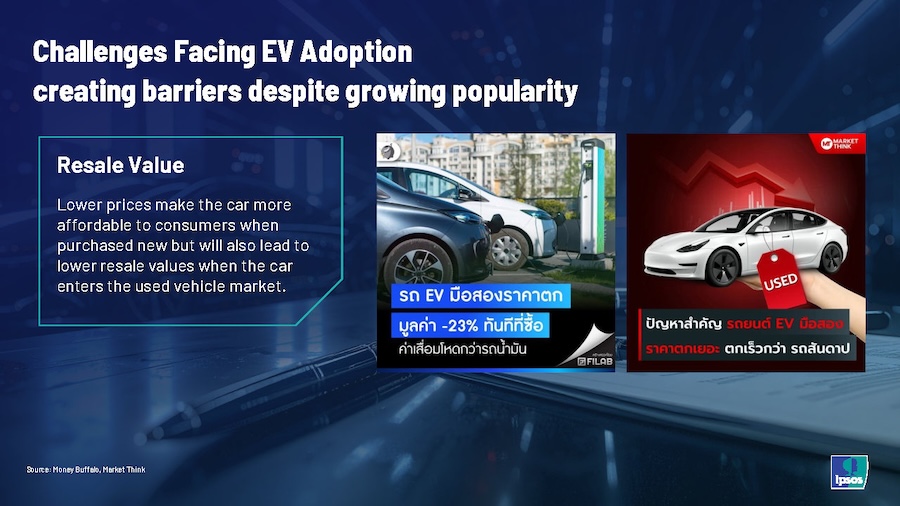
- Resale value: Although lower prices make it easier for consumers to own vehicles, it may lead to lower resale values in the used car market.
The Future of Combustion and Electric Vehicles
Mr. Setthasith also stated that internal combustion engine (ICE) vehicles will continue to play a significant role and will not disappear from Thailand's roads anytime soon. ICE vehicles will maintain a dominant market share in certain segments, especially in the pickup truck category, which has long been popular and is a crucial part of the Thai automotive landscape. While electric vehicle technology (BEV) is rapidly advancing, manufacturers continue to invest in improving ICE vehicles, such as launching new models that achieve impressive fuel efficiency. The coexistence of both technologies reflects a market in transition, where both will continue to compete for consumer attention, each offering unique features that meet different consumer needs and usage patterns.
Ipsos' Takeaways for Brand Builders and Marketers in the Electric Vehicle Market
The rapidly growing market indicates that the government's goal for Thailand to produce 30% of passenger vehicles as EVs by 2030 is becoming increasingly achievable, driven by supportive policies and rising consumer demand.
Key factors that will help manufacturers offer vehicles that resonate with consumers include a genuine understanding of consumer needs, as well as insights into both positive and negative perceptions of different vehicle types. This presents a significant challenge for the automotive market in Thailand, which is diverse in segments.
Competition is not limited to just engine types or power sources; it encompasses the entire process from decision-making, usage, to the long-term phase until a vehicle is replaced. Consumers will learn and seek information to determine whether a vehicle is worth the price they pay.